
Agentic AI Development at JFDI
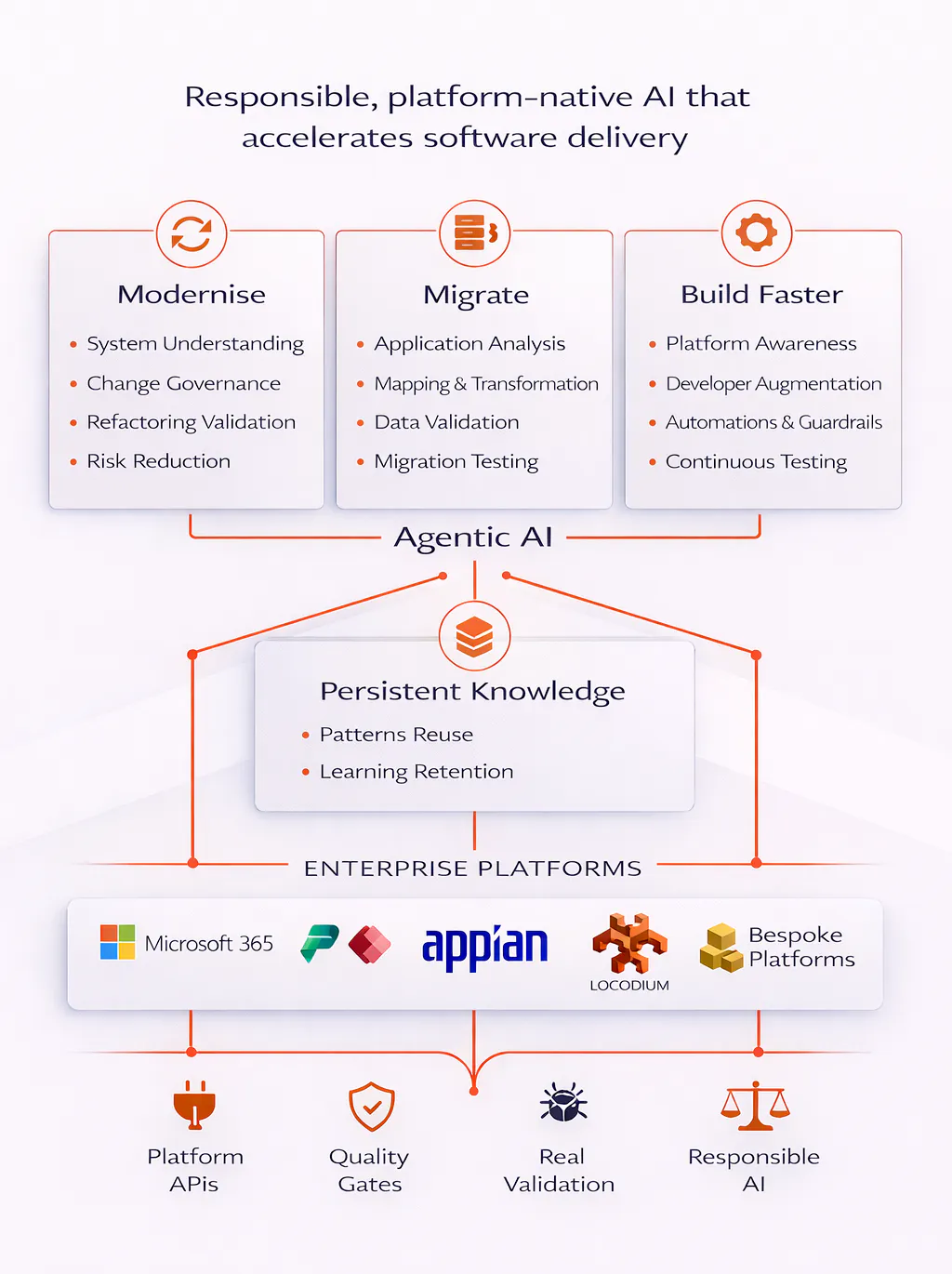
Built for real platforms. Designed for real delivery.
Agentic AI Development is how JFDI applies artificial intelligence to software engineering without compromising quality, governance, or trust.
Rather than treating AI as a novelty or a shortcut, we use agentic systems as a delivery capability:- one that accelerates development, strengthens modernisation, and works natively with enterprise platforms.
This is not experimental AI. It is AI designed to operate inside real systems, with real constraints, at real scale.
What do we mean by Agentic AI Development?
It is an approach where AI agents operate as active participants in the engineering process, not just a prompt-driven assistant.
At JFDI, this means those agents are given:
- Direct awareness of platform APIs and schemas
- Defined responsibilities within delivery workflows
- Automated validation and quality gates
- Persistent knowledge that compounds over time
The result is production-ready outputs, not plausible guesses that require extensive rework.
Why generic AI-assisted development falls short
Most AI-assisted development today relies on:
- Surface-level prompting
- Assumed platform behaviour
- Manual verification after the fact
- Disposable results that don’t learn from past work
In enterprise environments, this leads to:
- Hallucinated ouput and incorrect patterns
- Increased rework and technical debt
- Reduced confidence in AI-generated code
- Governance and audit concerns
Agentic AI exists to solve these problems, not introduce new ones.
At JFDI, Agentic AI Development is not a standalone service
It is an enabling capability that strengthens how we deliver across our core pillars:
Modernise
Modernisation requires care, context, and control. Agentic AI supports this by working with existing systems rather than against them in the following ways:
- Analyse legacy application structures before change
- Map existing schemas, dependencies, and workflows
- Apply governance and classification consistently
- Refactor safely using schema-aware validation
- Reduce risk during restructuring or replatforming
Agentic systems provide visibility before action. They test assumptions, highlight impact, and simulate change before it reaches production.
Modernisation succeeds when change is deliberate and informed. Agentic AI helps make that possible at scale.
Migrate
When organisations move applications, content, or workflows between platforms, the challenge is rarely the mechanics of transfer. It is understanding what exists, how it is structured, and how it should behave in the new environment.
Agentic AI strengthens migration by:
- Analysing existing application schemas and data models
- Mapping legacy structures to target platform architectures
- Identifying inconsistencies, redundancy, and data quality issues
- Simulating transformations before execution
- Validating migrated structures against real platform rules
- Continuously testing post-migration behaviour
This reduces risk, improves accuracy, and ensures that migration becomes an opportunity for improvement, not a replication of old complexity.
Build Faster
Agentic AI helps us accelerate delivery by removing friction from the engineering process, without lowering standards.
We use agentic pipelines to:
- Generate and validate platform-specific scaffolding
- Automate repetitive or error-prone implementation tasks
- Enforce consistent architectural and coding patterns
- Reduce rework caused by incorrect assumptions
- Continuously test outputs against real platform schemas and APIs
Augmenting our engineers, allowing them to focus on architecture, logic, and outcomes, while platform-specific heavy lifting is handled safely and consistently by AI.
Delivery becomes faster not because corners are cut, but because avoidable inefficiencies are removed.
What makes JFDI’s approach different
This is an engineering discipline applied to AI-assisted delivery
Platform-native by design
Our agentic systems interact directly with the platforms we work on, such as Microsoft 365, Power Platform, Appian, and bespoke enterprise environments. They don’t guess how platforms behave; they operate with real context.
Persistent knowledge
Patterns, fixes, and lessons learned are captured and reused. Knowledge compounds across projects instead of being lost between sessions.
Validation before delivery
Outputs pass through automated checks, tests, and platform-specific validation before being reviewed by humans. Quality is designed in, not inspected afterwards.
Human-led
Supporting our engineers, not replacing them. Architectural decisions, business logic, and accountability remain human-owned.
Why this matters to organisations
For organisations, this approach delivers:
- Faster development without lower standards
- Reduced technical debt from AI-generated code
- Improved governance and auditability
- Greater confidence in AI-assisted outcomes
- Knowledge that strengthens delivery over time
Allowing organisations to benefit without sacrificing control.
Where you’ll see this in practice
We apply these techniques when we:
- Build new applications and platforms
- Modernise legacy solutions
- Develop products such as Locodium, PETM, and our SharePoint web parts
- Automate governance, metadata, and compliance at scale
This is not theoretical. It is already embedded in how we deliver.
The Impact
Indicative outcomes based on client delivery experience. Actual results vary by organisation and context.
Faster Delivery Cycles
Typical reduction in time from concept to first usable release using agentic delivery patterns compared to traditional project models.
Reduced Rework & Waste
Fewer late-stage changes and rework cycles due to continuous agent-driven feedback, validation, and adjustment.
Faster Adaptation to Change
Time to adapt requirements, logic, or workflows is dramatically reduced as agents continuously monitor and propose changes.
Adoption & Usability
End users engage sooner thanks to earlier feedback loops and iterative refinement.
Our Agentic Development Manifesto
Defines the principles that guide how we use AI in engineering: prioritising correctness, accountability, and sustainability over speed alone. It is how those principles are applied in real delivery terms.
Start a conversation
If you’re exploring how AI fits into your development or modernisation strategy, we’re happy to talk.